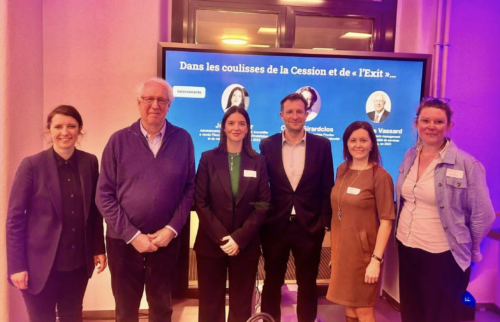
On March 23, 2023, the 6th edition of the ASAGE HR Career Forum took place: 135 participants were delighted to gather at the golf house of the Domaine Impérial in Gland (VD) to network with leading figures from the French-speaking Swiss business community and explore alternatives to traditional employment.
After the discussion workshops, all participants gathered for a brief sharing of conclusions and a social gathering featuring a cocktail reception: it was an enriching event, full of insights and inspiring encounters for the ASAGE participants.
Why this topic?
Between the “Great Resignation” and “quiet quitting,” companies and recruiters are noticing that more and more employees are seeking other forms of work—ones that offer greater freedom, align more closely with their values, and allow them to find more meaning in their professional lives.
We wanted to explore various options available to graduates of the grandes écoles outside of traditional employment, and how these experiences can be leveraged in a career path.
With the support of:
Summaries of the discussions in the 5 workshops:
1. Is this the end of linear careers?
Our guests: Nathalie Brodard, from Brodard Executive Search, and Marie Manin D’Haegeleer, from Procadres International Switzerland. Moderators: Christian Albrich (EMBA99-ESSEC) and Frédérique Ferté ( X-HEC)
Even though traditional employment still plays a dominant role, things are changing across all generations, and new ways of working are emerging. People are switching back and forth between traditional employment and self-employment more frequently, and “slashers”—people with multiple roles—hold several jobs or pursue multiple careers simultaneously. Since the pandemic, quality of life has become an important factor for job seekers. Part-time work, the 4-day workweek, partial remote work, and even “fully remote” arrangements are being requested more often.
At the same time, companies are slow to recognize the value of non-traditional career paths. This openness depends heavily on a company’s culture and its ability to embrace a certain degree of “non-conformity”—or even turn it into an asset. The Swiss market is evolving in this regard, though it is not at the forefront of this trend.
It’s always possible to venture beyond traditional career paths; keep in mind that starting your own business requires additional skills, such as cash flow management and the ability to market your services. Returning to corporate life is just as possible after an entrepreneurial or self-employed experience, though it can sometimes come with a sense of lost freedom.
2. Interim Management
Guests: Olivier Taburet , Founding Partner of Procadres International, Markus Müller-Yee, and Alain Le Berre, Interim managers and consultants
These assignments, which last a few months or longer, are most often carried out by managers with solid prior experience, which allows them to arrive equipped with a robust set of skills and make an immediate impact with clients. The success of an assignment depends on the ability to listen, which is essential for identifying the optimal solution, implementing it, and gaining acceptance for it.
Key message: Interim management has a bright future in an increasingly unstable economic climate, and it allows individuals to capitalize on the experience and expertise they have gained throughout their careers.
3. Take over a business
AlongsideOlivier Dupont, Head of Business Development at the CCIFS: Patricia Lemattre-Stoeckel, CEO of VeePee Switzerland, and Marco Fedrigucci, CEO of Moléson Impressions
Taking over a business can be compared to getting married.
Beyond the technical aspects, what matters most is the personal relationship that develops between the new owner and the existing teams, as well as shared values. Some situations can be difficult to handle, and it’s important to take the time needed for the transition, even when there’s pressure to move quickly.
Key message: Confidence, passion, and courage are essential qualities that a business buyer must possess.
4. Board of Directors Appointments
Our guests:Anne Bobillier, a member of several boards of directors, and Jean-Luc Chenaux, Esq., Chairman of the Board of Directors of Assura. Moderator: Françoise Lamotte, Director of Innovation at Terre des Hommes.
The role of directors: to ensure the company’s long-term growth, taking into account stakeholders, strategy, risk management, and financial management. More recently, issues related to digital transformation, cybersecurity, and ESG have been added to this list.
What qualities are needed to become an independent director? Boards seek a diverse group of individuals who can work effectively as a team. Each member must be able to address all topics; as such, operational experience in senior management is important. In addition, specific skills that add value to the board (such as strategy, auditing, and legal expertise) are desirable. Diversity ensures effective functioning and high-quality decision-making.
How do you become a director? Make yourself known through networking and headhunters; develop your skills and demonstrate your value; training is a plus in terms of knowledge and the confidence to take on your first advisory role.
What are the main challenges of the role? Availability (which is more critical in a startup), especially during times of crisis; true independence (the ability to voice disagreement, and the option to resign if necessary). Legal liability should not be underestimated (the importance of due diligence before joining a board).
Key message: You can’t just become a manager overnight; you need training and a comprehensive understanding of the company, beyond your expertise in a single area.
5. Starting Your Own Business
Our guests: Virginie Staub, founder of Women Impact; Siddhi Metha, founder of Rhythm 108; and Franck Milet, founder of VR4Business.
From the very beginning, it’s important to surround yourself with the right people to break the isolation of being an entrepreneur—and, if possible, to have a mentor. It’s important to realize that, beyond business development, the fundamental aspects are running your business and managing your accounting. And keep in mind that being an entrepreneur is exciting, but it’s a real marathon!
Key message: Being passionate about moving forward and following your dreams is the key to success!
We would like to extend our heartfelt thanks to our guests, who enriched these discussions with their professional insights and by sharing their personal journeys.
The Swiss Association of Friends of the Grandes Écoles brings together the 20 leading associations of European business and engineering schools (www.asage.ch). It has more than 15,000 alumni.
Every year, the ASAGE HR Career Forum is organized by teams of volunteer alumni from these programs. The event brings together about 100 participants to discuss an HR-related topic with leading figures from the French-speaking Swiss business community.
Congratulations to the Rencontres RH 2023 team:
Christian Albrich, Marc Berger, Bruno Descorps, Frédérique Ferté, Julien Guerle, Françoise Lamotte, Sophie Le Guennec, Olivier de Magny, Pauline Mollard Giboudeau, Nicolas Razin, Olga Semenenko, Virginie Staub, Hélène Rau, and Isabelle Laugier.
With the support of:
PROCADRES INTERNATIONAL SWITZERLAND
2 videos produced by Procadres
1 – Interview with Isabelle Laugier:
2 – Interview with Stéphane Lury: